强化学习 Reinforcement Learning
(Chrome无法播放优酷? 网址框输入"chrome://settings/content/", 勾选允许 Flash Player. 实在不行? 请 点击这里)
Policy Gradients 思维决策 (Tensorflow)
作者: 莫烦 编辑: 莫烦 2017-03-21
学习资料:
- 全部代码
- 什么是 Policy Gradient 短视频
- 本节内容的模拟视频效果:
- 论文 Policy gradient methods for reinforcement learning with function approximation.
接着上节内容, 我们来实现 RL_brain 的 PolicyGradient 部分, 这也是 RL 的大脑部分, 负责决策和思考.
要代码主结构
用基本的 Policy gradient 算法, 和之前的 value-based 算法看上去很类似.
class PolicyGradient:
    # 初始化 (有改变)
    def __init__(self, n_actions, n_features, learning_rate=0.01, reward_decay=0.95, output_graph=False):

    # 建立 policy gradient 神经网络 (有改变)
    def _build_net(self):

    # 选行为 (有改变)
    def choose_action(self, observation):

    # 存储回合 transition (有改变)
    def store_transition(self, s, a, r):

    # 学习更新参数 (有改变)
    def learn(self, s, a, r, s_):

    # 衰减回合的 reward (新内容)
    def _discount_and_norm_rewards(self):
初始化
初始化时, 我们需要给出这些参数, 并创建一个神经网络.
class PolicyGradient:
    def __init__(self, n_actions, n_features, learning_rate=0.01, reward_decay=0.95, output_graph=False):
        self.n_actions = n_actions
        self.n_features = n_features
        self.lr = learning_rate     # 学习率
        self.gamma = reward_decay   # reward 递减率

        self.ep_obs, self.ep_as, self.ep_rs = [], [], []    # 这是我们存储 回合信息的 list

        self._build_net()   # 建立 policy 神经网络

        self.sess = tf.Session()

        if output_graph:    # 是否输出 tensorboard 文件
            # $ tensorboard --logdir=logs
            # http://0.0.0.0:6006/
            # tf.train.SummaryWriter soon be deprecated, use following
            tf.summary.FileWriter("logs/", self.sess.graph)

        self.sess.run(tf.global_variables_initializer())
建立 Policy 神经网络
这次我们要建立的神经网络是这样的:
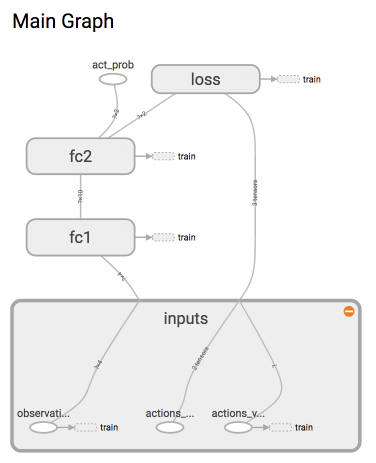
因为这是强化学习, 所以神经网络中并没有我们熟知的监督学习中的 y label. 取而代之的是我们选的 action.
class PolicyGradient:
    def __init__(self, n_actions, n_features, learning_rate=0.01, reward_decay=0.95, output_graph=False):
        ...
    def _build_net(self):
        with tf.name_scope('inputs'):
            self.tf_obs = tf.placeholder(tf.float32, [None, self.n_features], name="observations")  # 接收 observation
            self.tf_acts = tf.placeholder(tf.int32, [None, ], name="actions_num")   # 接收我们在这个回合中选过的 actions
            self.tf_vt = tf.placeholder(tf.float32, [None, ], name="actions_value") # 接收每个 state-action 所对应的 value (通过 reward 计算)

        # fc1
        layer = tf.layers.dense(
            inputs=self.tf_obs,
            units=10,   # 输出个数
            activation=tf.nn.tanh,  # 激励函数
            kernel_initializer=tf.random_normal_initializer(mean=0, stddev=0.3),
            bias_initializer=tf.constant_initializer(0.1),
            name='fc1'
        )
        # fc2
        all_act = tf.layers.dense(
            inputs=layer,
            units=self.n_actions,   # 输出个数
            activation=None,    # 之后再加 Softmax
            kernel_initializer=tf.random_normal_initializer(mean=0, stddev=0.3),
            bias_initializer=tf.constant_initializer(0.1),
            name='fc2'
        )

        self.all_act_prob = tf.nn.softmax(all_act, name='act_prob')  # 激励函数 softmax 出概率

        with tf.name_scope('loss'):
            # 最大化 总体 reward (log_p * R) 就是在最小化 -(log_p * R), 而 tf 的功能里只有最小化 loss
            neg_log_prob = tf.nn.sparse_softmax_cross_entropy_with_logits(logits=all_act, labels=self.tf_acts) # 所选 action 的概率 -log 值
            # 下面的方式是一样的:
            # neg_log_prob = tf.reduce_sum(-tf.log(self.all_act_prob)*tf.one_hot(self.tf_acts, self.n_actions), axis=1)
            loss = tf.reduce_mean(neg_log_prob * self.tf_vt)  # (vt = 本reward + 衰减的未来reward) 引导参数的梯度下降

        with tf.name_scope('train'):
            self.train_op = tf.train.AdamOptimizer(self.lr).minimize(loss)
选行为
这个行为不再是用 Q value 来选定的, 而是用概率来选定. 即使不用 epsilon-greedy, 也具有一定的随机性.
class PolicyGradient:
    def __init__(self, n_actions, n_features, learning_rate=0.01, reward_decay=0.95, output_graph=False):
        ...
    def _build_net(self):
        ...
    def choose_action(self, observation):
        prob_weights = self.sess.run(self.all_act_prob, feed_dict={self.tf_obs: observation[np.newaxis, :]})    # 所有 action 的概率
        action = np.random.choice(range(prob_weights.shape[1]), p=prob_weights.ravel())  # 根据概率来选 action
        return action
存储回合
这一部很简单, 就是将这一步的 observation, action, reward 加到列表中去.
因为本回合完毕之后要清空列表, 然后存储下一回合的数据, 所以我们会在 learn() 当中进行清空列表的动作.
class PolicyGradient:
    def __init__(self, n_actions, n_features, learning_rate=0.01, reward_decay=0.95, output_graph=False):
        ...
    def _build_net(self):
        ...
    def choose_action(self, observation):
        ...
    def store_transition(self, s, a, r):
        self.ep_obs.append(s)
        self.ep_as.append(a)
        self.ep_rs.append(r)
学习
本节的 learn() 很简单, 首先我们要对这回合的所有 reward 动动手脚, 使他变得更适合被学习.
第一就是随着时间推进, 用 gamma 衰减未来的 reward, 然后为了一定程度上减小 policy gradient 回合 variance,
我们标准化回合的 state-action value 依据在 Andrej Karpathy 的 blog.
class PolicyGradient:
    def __init__(self, n_actions, n_features, learning_rate=0.01, reward_decay=0.95, output_graph=False):
        ...
    def _build_net(self):
        ...
    def choose_action(self, observation):
        ...
    def store_transition(self, s, a, r):
        ...
    def learn(self):
        # 衰减, 并标准化这回合的 reward
        discounted_ep_rs_norm = self._discount_and_norm_rewards()   # 功能再面

        # train on episode
        self.sess.run(self.train_op, feed_dict={
             self.tf_obs: np.vstack(self.ep_obs),  # shape=[None, n_obs]
             self.tf_acts: np.array(self.ep_as),  # shape=[None, ]
             self.tf_vt: discounted_ep_rs_norm,  # shape=[None, ]
        })

        self.ep_obs, self.ep_as, self.ep_rs = [], [], []    # 清空回合 data
        return discounted_ep_rs_norm    # 返回这一回合的 state-action value
我们再来看看这个 discounted_ep_rs_norm 到底长什么样, 不知道大家还记不记得上节内容的这一段:
vt = RL.learn() # 学习, 输出 vt, 我们下节课讲这个 vt 的作用

if i_episode == 0:
    plt.plot(vt)    # plot 这个回合的 vt
    plt.xlabel('episode steps')
    plt.ylabel('normalized state-action value')
    plt.show()
我们看看这一段的输出, vt 也就是 discounted_ep_rs_norm, 看他是怎么样诱导我们的 gradient descent.
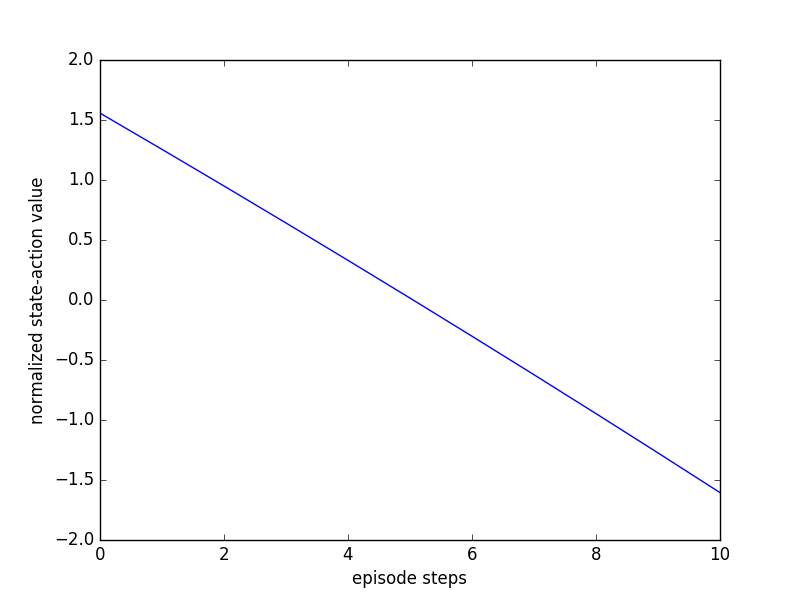
可以看出, 左边一段的 vt 有较高的值, 右边较低, 这就是 vt 在说:
“请重视我这回合开始时的一系列动作, 因为前面一段时间杆子还没有掉下来. 而且请惩罚我之后的一系列动作, 因为后面的动作让杆子掉下来了” 或者是
“我每次都想让这个动作在下一次增加被做的可能性 (grad(log(Policy))),
但是增加可能性的这种做法是好还是坏呢?
这就要由 vt 告诉我了, 所以后段时间的 增加可能性 做法并没有被提倡, 而前段时间的
增加可能性 做法是被提倡的.”
这样 vt 就能在这里 loss = tf.reduce_mean(log_prob * self.tf_vt)
诱导 gradient descent 朝着正确的方向发展了.
如果你玩了下 MountainCar 的模拟程序, 你会发现 MountainCar 模拟程序中的 vt 长这样:
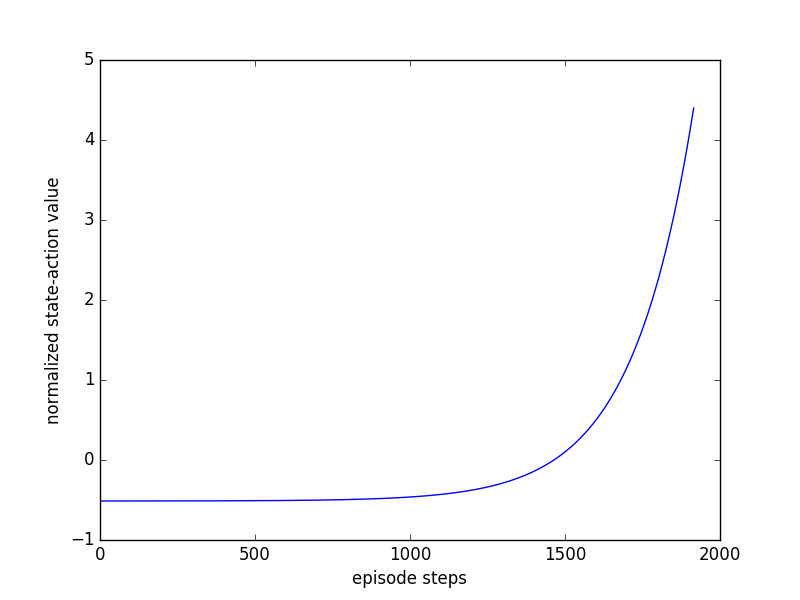
这张图在说: “请重视我这回合最后的一系列动作, 因为这一系列动作让我爬上了山. 而且请惩罚我开始的一系列动作, 因为这些动作没能让我爬上山”.
也是通过这些 vt 来诱导梯度下降的方向.
最后是如何用算法实现对未来 reward 的衰减.
class PolicyGradient:
    def __init__(self, n_actions, n_features, learning_rate=0.01, reward_decay=0.95, output_graph=False):
        ...
    def _build_net(self):
        ...
    def choose_action(self, observation):
        ...
    def store_transition(self, s, a, r):
        ...
    def learn(self):
        ...
    def _discount_and_norm_rewards(self):
        # discount episode rewards
        discounted_ep_rs = np.zeros_like(self.ep_rs)
        running_add = 0
        for t in reversed(range(0, len(self.ep_rs))):
            running_add = running_add * self.gamma + self.ep_rs[t]
            discounted_ep_rs[t] = running_add

        # normalize episode rewards
        discounted_ep_rs -= np.mean(discounted_ep_rs)
        discounted_ep_rs /= np.std(discounted_ep_rs)
        return discounted_ep_rs
如果想一次性看到全部代码, 请去我的 Github
莫烦Python